


If there is something universally true about TV directors, it is these two things:
There are never enough cameras. No matter how many you give them, they will always ask for more.
And if you give them a new toy, a new resource, a new piece of gear, they will use it as much as they possibly can. Every shot. Every angle. Every chance they get, just to justify having it.
Now, I am not talking about all directors. But it happens with most of them, especially the younger ones.
The veterans already understand something that takes years to learn: just because you have the most luxurious camera or the most advanced technology doesn’t mean it needs to be in every shot. They know that camera numbers are not the reason a great show is a great show.
I want to highlight this because of what I saw this past week.
The Winter Olympics Got It Right
If you have been watching the Milano Cortina Winter Olympics, you already know what I am about to say.
The FPV drones.
They have been delivering breathtaking shots in skiing, luge, and speed skating. The kind of perspectives that make you feel like you are right there on the mountain, on the ice, inside the competition.
But here is what impressed me the most, they are not overusing them.
The drones show up at the right moments. They help tell the story of speed. They reveal the complexity of the landscape where these athletes are competing. They give context, emotion, and information, all without overstaying their welcome.
It is so beautiful to watch how the production teams are deploying FPV drones at these Olympics that I did not want to miss the opportunity to highlight it. They are not showing off the technology. They are using the technology to show off the athletes and the sport.
That is a massive difference.

One Camera. One Shot. Forever.
Now let me take you to the Super Bowl.
Obviously, the game was well covered at the highest level. The halftime show, whether you liked it or not, was also great from a production standpoint.
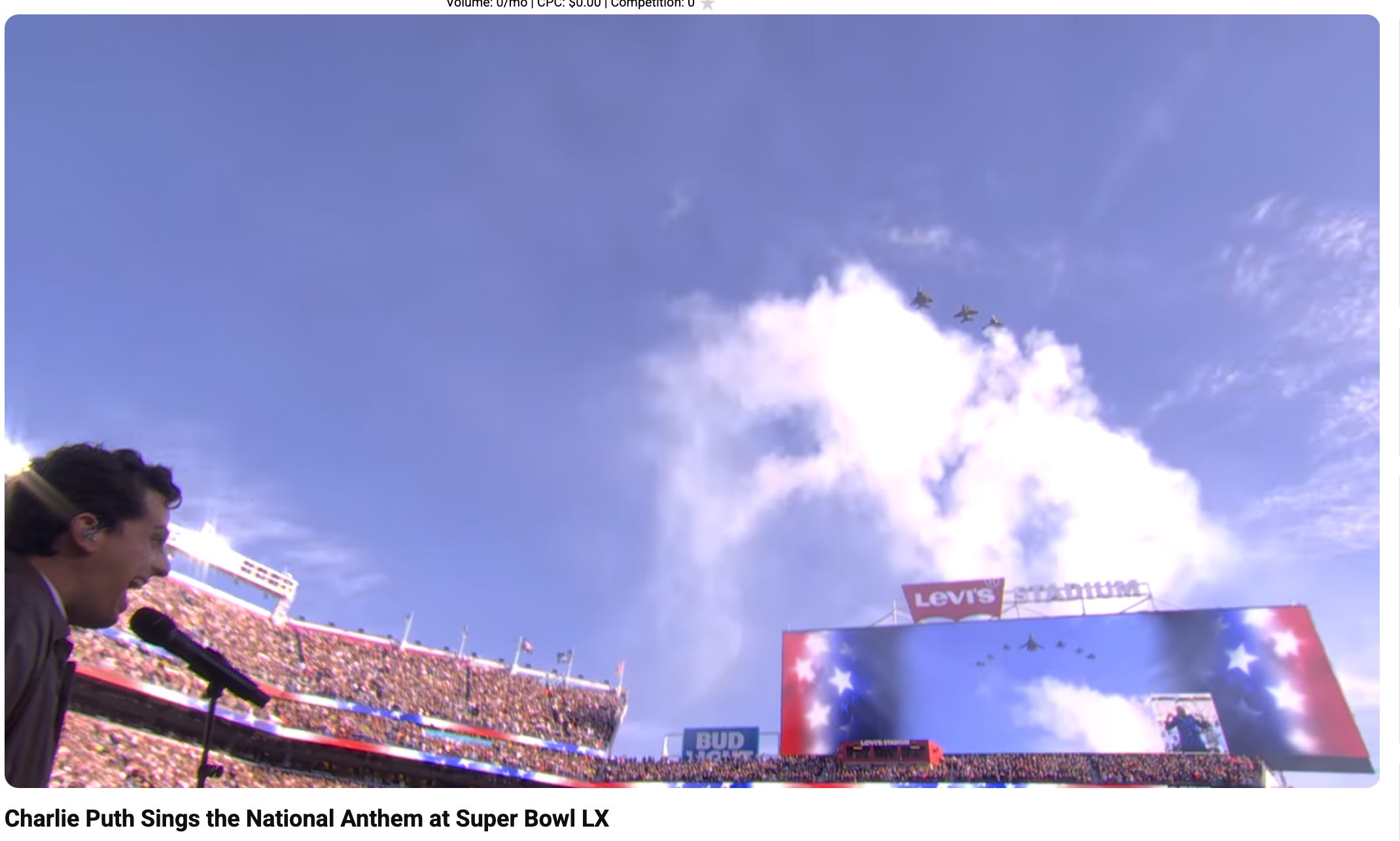
But I want to point you to the pre-game ceremony. Specifically, when Charlie Puth was singing the U.S. national anthem.
There is a shot that, to me, is extraordinary.
Charlie Puth is singing. A steadicam operator has him framed perfectly. And then, at the exact right moment, the operator, zooms out, tilts up, smoothly, precisely, to reveal a formation of U.S. military jets flying over Levi’s Stadium.
From the singer to the sky. One continuous movement. One camera.
In principle, it seems easy. You might say, “Yeah, anyone could do that.” But think about it. One operator. One camera. One chance to get it right. The timing had to be perfect: the tilt, the speed, the framing, the coordination with the flyover. There was no second take.
They did it not once, but twice.
Those shots will live forever in the memory of anyone who appreciates great television. And it was not a drone. It was not an aerial. It was one Steadicam, operated by someone who knew exactly what they were doing, guided by a director and producers who gave the exact right call at the exact right moment.
What I keep learning
Here is what both of these examples remind us:
Resources should be used to tell a story. Resources should not be the story.
Having drones is not the story. How you use those drones to show the speed of a downhill skier, the danger of a luge track, the scale of a skating oval, that is what makes them valuable.
You could have hundreds of cameras at the Super Bowl. But it might be the one Steadicam, one of the usual tools in the compound, that gives you the shot everyone remembers for the rest of their lives.
The next time you are planning a production, ask yourself: am I adding this resource because it helps me tell a better story, or because I want to have it on the truck?
There is a big difference between the two.
If you watched the Milano Cortina Olympics, the Super Bowl, or even tonight’s NBA All-Star Game, and something caught your eye (a shot, a transition, a moment of great television) share it with me. Hit reply.
The more we discuss these details, the more we learn. And the more we learn, the better we get at putting resources to work in our own productions.
Talk soon,
Oscar S.
I could not agree more, once again, with you. I keep telling my producers and directors that they should focus on telling the story of the athletes journey by doing their job and choosing the right shots and the right camera men. By doing a simple and sometimes repetitive action cut, the spectator understands the action better and by sprinkling in some effective emotional moments and wow factors the viewer, no matter on what device is sold. Especially when it still seems to be the trend to show muscle by throwing as many cameras and toys at broadcasts as possible, thinking that they will be better. In many cases less is more, but the operators and the editorial crew needs to do their job and follow the action and tell those beautiful stories. Yesterdai Brazil won the first ever gold in a winter Olympics and the FPV, followed Lucas acroos the course and the finish line in an elegant and natural way that showed the emotion of the action and afterwards the EVS ops compiled the most tear jerking moments into a beautiful sequence.
As you said Oscar, it's all about using technology to tell the story better.
What was missed with the Super Bowl? Sign Language. A big deal was made up front, but yiu needed to know where to find it as the show was happening. With the full deployment of ATSC3 it will be easier to select an option. For now? You need to know what media option to tune into.
Finally, expertise, experience and planning create those memorable moments.